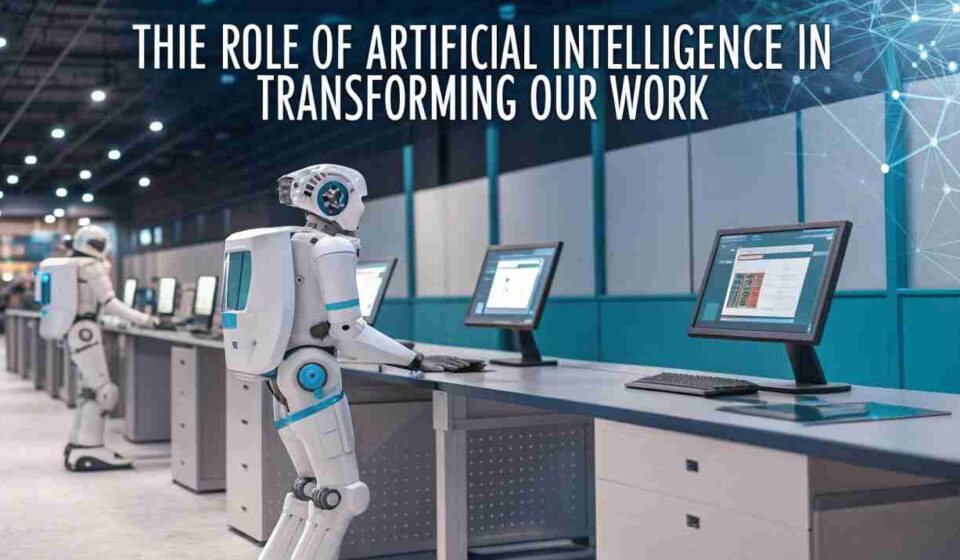

Artificial intelligence, or AI, was not so long ago a thing you could find in science fiction films. Robots speaking, machines reasoning, computers making large decisions without any human intervention. All this felt like a fairy tale. However, nowadays AI is quite a reality, and it is gradually transforming how millions of individuals work on a daily basis. You may be in an office, a hospital, a factory, or a farm, but AI is likely to be a part of your life, whether you know it or not.
What then is AI? In the most fundamental sense, AI is a set of computer systems that are able to perform tasks that are traditionally handled by human intelligence. Such things as learning by doing, complex problem solving, language, and finding patterns in large volumes of data. It is not magic. It is data, math and a great deal of very clever programming. But the results are even a bit magical to the first-time witness to it at work.
AI in the Workplace: What’s Changing.
The workplace is one of the largest areas where AI is emerging. Both large and small companies are employing AI to complete tasks that would otherwise have required a human being hours, or even days. Consider customer service chatbots you can talk to at midnight when no human agent is on duty. Or a software which is able to scan through a thousand or more job applications within a few seconds and sort the best qualified applicants. These are labor-free tools that do not require a coffee break and are becoming smarter each and every month.
This has been both good and bad for the workers. On the bright side, AI will eliminate monotonous and tedious work that no one likes to do. No one really enjoys sifting through hundreds of emails or pasting data into spreadsheets all afternoon. AI takes care of that type of grunt work, releasing people to be able to engage more in creative, thoughtful, and meaningful work. Physicians are able to devote more time to patients, rather than completing paperwork. Educators are able to pay attention to learners, other than marking multiple-choice exams. Instead of preparing standard reports, engineers are able to solve the large issues.
Conversely, job security is a concern to some individuals. When a machine can perform your job faster, cheaper and with no complaints, what does it do to your future? This is the truth of the matter: certain jobs will be changed, and certain jobs will be eliminated. History tells us, though, that new technology nearly always provides new types of work as well. When ATMs came several decades ago, many individuals had forecasted the disappearance of bank tellers. Rather, banks increased branches and, in fact, employed more people. The same can be said about AI, as new opportunities will emerge, new skills will be needed, and new positions will become available.
The Bigger Picture: AI in all industries.
Not only in single workplaces, but also in industries, AI is changing the face of the industry or business in ways that are unimaginable within a decade. Retailers are leveraging AI to anticipate what their customers desire, even before they are aware of themselves. AI is applied by doctors and medical researchers to more quickly and accurately identify diseases in scans and lab outcomes than can be done using human experts alone. With AI-enabled tools, farmers are able to monitor the soil conditions and crop health, and use less water to grow more food with fewer resources.
Transport is evolving as well. AI-powered self-driving vehicle technology is under trial on the road. Airlines adopt AI to plan flight routes and conserve fuel. Shipping companies can use AI to make their deliveries more efficient, reaching your door quicker.
Naturally, AI is not flawless. It errs, and even at times with great expense. It may be biased when the information it trains on is biased– and much of the data in the real world is. It poses some grave moral inquiries: Who is accountable when an AI makes a wrong decision? What is the solution to AI systems stealing and analyzing such levels of personal information? It is the kind of conversation that needs to be continued by society with the increasing strength of technology.
However, there is one thing that is quite clear: AI is here to stay. Mastering how to deal with it, as opposed to being afraid of it, is becoming one of the most important skills of our era. AI will somehow find its way to your world, whether you are a student, a nurse, a teacher or a mechanic. The best thing to do now? Become interested in it. Explore it. Know how to make it happen. Since the individuals who compute that early will have a real benefit in the coming years. This is the future of work, and it does not only look like humans and machines collaborating, but it is a rather exciting perspective.