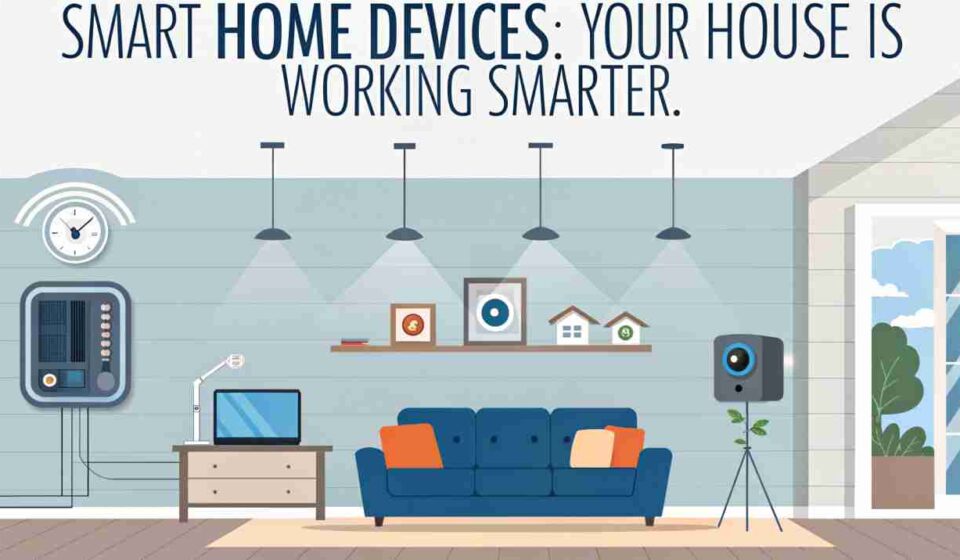

Suppose you were able by a single word to have all the lights of your whole house put out. Or know who precisely is knocking on your front door even as you are sitting on your office desk across the town? Or can the heating and cooling system of your home be programmed to know your day-to-day routine and automatically regulate itself so that you are never too hot or too cold but always comfortable without wasting power when nobody is around? This is what smart home technology promises. And in the majority of these cases, the technology has kept pace with the promise.
Smart home devices are devices that are connected to your home’s internet network and can either be controlled by your smartphone or by voice command. Since the time of smart light bulbs and programmable thermostats, the smart home ecosystem has grown immensely in the last few years, with video doorbells and robot vacuums being some of the newest additions. And prices have fallen to such a degree that this technology is no longer a preserve of tech lovers who have large incomes. A lot of smart home basics can now be available to anyone.
Where the greatest number begin–and why it works.
The devices that most commonly initiate the process of a smart home are through smart speakers, like Amazon Echo and Google Nest Hub, and rightfully so. They are also comparably inexpensive, simple to install, and immediately applicable. Having a smart speaker running is the brain of your home. You can have it turn off the lights, play your morning playlist, see the weather forecast, set a cooking timer, answer your random questions or remind you about your next appointment, without even touching anything.
Another starting point of low commitment that is popular is smart lights. Lamps such as Philips Hue are both controllable by phone or by voice and provide bulbs and light strips. You can also program lights to gradually light up in the morning like a real sunrise, to wake you up more smoothly than a startling alarm. You can program them to change colour or switch off automatically at a specific time at night. You can even make them pulse or change color when you get a certain notification on your phone – useful when you are at home and need to know when a very important message has been received.
Smart thermostats are one of the smartest investments in the smart home realm, both in terms of convenience and your energy bill. The Nest Learning Thermostat and the Ecobee are devices that monitor your routine and create a program that will make your home comfortable when you are there and will use less energy when you are away. Most users experience significant savings to their monthly electricity bill within the initial year – and in some cases, enough to cover the cost of the device.
Security, Privacy, and Things to Know Before Building Your Smart Home.
Video doorbells such as Ring and Arlo have gained immense popularity among both homeowners and renters. Be in any part of the world to know who is at the door. Get a real-time notification of a package delivery. Check footage of any person who came to your door during the night. To individuals who are living alone or commuting a lot, this type of simple, affordable security gives true peace of mind.
Robot vacuums are no longer a fad; they are now a real household necessity. The newest models made by iRobot, Roborock, and others map out the layout of your home in detail, work around objects and clean when you are away at work or sleeping. They also do cleaning and maintenance between the deeper cleaning sessions to ensure that your floors are always cleaner with minimal effort on your part.
Nonetheless, there are actual issues that are worth considering with regard to smart home technology. Privacy is at the top of the list. Smart speakers continuously listen to their wake word, and cameras capture images of your house and property. Before you introduce a device into your home, it is always a good idea to know what kind of data is being collected by the company, how long they keep it and who they share it.
The issue of compatibility has been a bane in the past between devices of different brands. The sector is shifting towards a common standard known as Matter that will make it considerably easier to mix and match brands. To date, being confined to one ecosystem, Amazon, Google, or Apple, is likely to create the most seamless experience. One device at a time, discover what actually makes your life easier, and build on it.