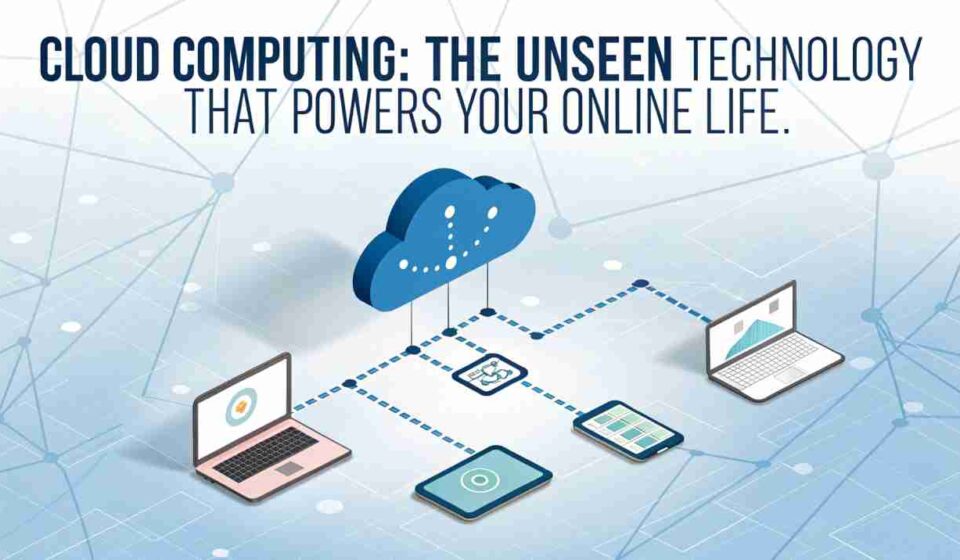

This is an easy question to answer with an unexpected answer: what happens to your photos when you save them to your phone? In what location is your Netflix library? In which folder do you save your work document to Google Drive? The solution in the three situations is the cloud. And as the term itself is soft and abstract, one of the most potent and transformative forces that is changing our digital world today is cloud computing. It is touched on in almost every activity that you do on the internet.
Cloud computing is merely the internet-based method of storing, managing and processing data rather than performing all of that locally on your own computer. You don’t have to have your laptop struggling to perform all your tasks locally; instead, heavy servers in enormous data centers around the globe do the heavy lifting. You can get everything online using any device, anytime, anywhere. It operates silently in the background- and most individuals never consider anything about it until the internet fails.
The way the Cloud Revolutionized Business.
Cloud computing has been nothing short of a revolution for businesses. In the days before the cloud, companies needed to purchase and keep their own physical servers. That implied massive initial investments, huge layers of IT personnel and even rooms of hardware that became obsolete after a few years. It was costly, time-consuming, and vexing to keep all that.
The cloud transformed it all. Businesses can now rent only the amount of computing power that they require. When demand goes nuts, such as when a retailer needs to handle a flood of demands on a holiday, they can be spun up immediately, and when the demand subsides, they can be spun down. They only pay what they consume, such as the payment of a utility bill. There is no longer any purchase of costly hardware that is not in use most of the time.
This shift is particularly beneficial to startups. Even when a small team has a great idea, it can introduce a world-changing app without having to spend millions developing infrastructure. The same computing power that is used by huge corporations is made available to them at a fraction of the cost. The fact that access has truly lowered the playing field and contributed to the last ten years being a decade of innovation and new business creation is real.
The collaboration between the teams was also revolutionized by cloud computing. Google Docs also allows a number of individuals to work on the same document, even in other nations. Millions of calls are made on video conferencing platforms daily. The cloud was actually what kept businesses, schools, and governments operating during the pandemic when the whole world was forced to work at night.
The Advantages, the Dangers, and What You ought to know.
To the common users, the cloud is of tremendous convenience. Your photos are automatically saved and can be viewed on all your devices. You can begin watching a television show on your TV, stop watching it and resume right where you left off on your phone. Now you can send huge files to anybody anywhere in the world within a few seconds. You may do your job at home, a coffee shop, or even on the other side of the planet.
However, there are trade-offs associated with the cloud that are worth being aware of. The fact that you are storing the most sensitive data online is a valid cause of concern in terms of privacy. Cloud providers spend huge amounts of money on security, but none of the systems can be fully resistant to breaches. One should consider prudently what they store, where, and on what terms.
Another consideration is reliability. In case of an outage of a large cloud provider, which does occur a few times a year, businesses and users who are reliant on it are left without access to their data. And even to people in regions with slow or unreliable internet, the cloud-first solution may be more of a liability than an asset.
Nevertheless, the benefits greatly exceed the downsides for the majority of individuals and the majority of companies. The cloud itself is more than a fad; it is the stable base of the new digital economy. All of your favorite apps, all of your favorite services, all of your favorite content you stream are probably powered by it. Knowing how it operates and what you can do with your data to be prudent places you in an even greater position in a world that is becoming more interconnected.